没啥难度,和上次55开(除了我僵硬的一p)
Bike Tour Bike Tour.cpp 1 2 3 4 5 6 7 8 9 10 11 12 13 14 15 16 17 18 19 #include <bits/stdc++.h> using namespace std ;int main () int T; cin >> T; for (int cas = 1 ; cas <= T; ++cas) { int n; cin >> n; vector <int > a (n) for (int &i : a) cin >> i; int ans = 0 ; for (int i = 1 ; i < n - 1 ; ++i) { if (a[i] > a[i - 1 ] && a[i] > a[i + 1 ]) ++ans; } cout << ans << endl ; } return 0 ; }
Bus Rountes Bus Rountes.cpp 1 2 3 4 5 6 7 8 9 10 11 12 13 14 15 16 17 18 19 20 21 #include <bits/stdc++.h> using namespace std ;typedef long long ll;int main () int T; cin >> T; for (int cas = 1 ; cas <= T; ++cas) { int n; ll d; cin >> n >> d; vector <ll> a (n) for (ll &i : a) cin >> i; ll las = d; for (int i = n - 1 ; i >= 0 ; --i) { las = las / a[i] * a[i]; } ll ans = las; cout << "Case #" << cas << ": " << ans << endl ; } return 0 ; }
Robot Path Decoding 差不多就是模拟叭,就是加()可以当作递归写,反正数据范围很小,统计贡献方便且快。
Robot Path Decoding.cpp 1 2 3 4 5 6 7 8 9 10 11 12 13 14 15 16 17 18 19 20 21 22 23 24 25 26 27 28 29 30 31 32 33 34 35 36 37 38 39 40 41 42 43 44 45 46 47 48 49 50 #include <bits/stdc++.h> using namespace std ; typedef long long ll; typedef pair<ll, ll> pll; pll go (string &s, int l, int r, int mul) { pll res; for (int i = l; i <= r; ++i) { if (isdigit(s[i])) { int cnt = 0 ; for (int j = i + 1 ; j <= r; ++j) { if (s[j] == '(') ++cnt; if (s[j] == ')') --cnt; if (cnt == 0 ) { pll t = go (s, i + 1 , j, s[i] - '0 '); i = j; res.first += t.first ; res.second += t.second ; break ; } } } if (s[i] == 'N') res.first += mod - 1 ; else if (s[i] == 'S') res.first += 1 ; else if (s[i] == 'E') res.second += 1 ; else if (s[i] == 'W') res.second += mod - 1 ; if (res.first > mod ) res.first % = mod ; if (res.second > mod ) res.second % = mod ; } res.first = res.first * mul; res.second = res.second * mul; if (res.first > mod ) res.first % = mod ; if (res.second > mod ) res.second % = mod ; return res; } int main() { int T; cin >> T; string s; for (int cas = 1 ; cas <= T; ++cas) { cin >> s; pii ans = go (s, 0 , s.length () - 1 , 1 ); ans.first ++; ans.second ++; if (ans.first > mod ) ans.first % = mod ; if (ans.second > mod ) ans.second % = mod ; printf ("Case #%d: %d %d\n" , cas, ans.second , ans.first ); } return 0 ; }
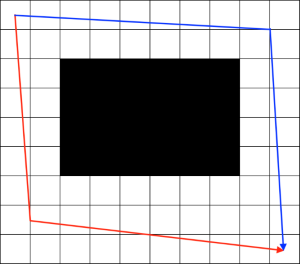
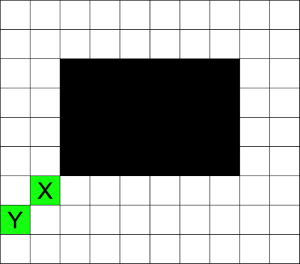
Wandering Robot 看了题解分析后,感觉写了这么久题,反而把计算机最原始的数值计算的功能忽略了,所以被精度问题绝杀。
分析一下可以想到假设每个格子都能走的话,走到位于$(x,y)$的概率斜着看是二项式系数除$2^n$,所以问题就变成求一些格子上$\frac{C_n^k}{2^n}$的和。
由于求$\frac{C_n^k}{2^n}$中间太大,可以把换成$e^{\ln{\frac{C_n^k}{2^n}}} = e^{\ln{n!}-\ln{k!}-\ln{(n-k)!}-\ln{2^n}}$,预处理一下,就可以算了。
Wandering Robot.cpp 1 2 3 4 5 6 7 8 9 10 11 12 13 14 15 16 17 18 19 20 21 22 23 24 25 26 27 28 29 30 31 32 33 34 35 36 37 38 39 40 41 42 43 44 #include <bits/stdc++.h> using namespace std ;const int N = 2e5 + 5 ;double ln_fac[N], p[N];double calc (int k, int n) return exp (ln_fac[n] - ln_fac[k] - ln_fac[n - k] - p[n]); } int main () p[1 ] = log (2 ); for (int i = 2 ; i < N; ++i) { ln_fac[i] = ln_fac[i - 1 ] + log (i); p[i] = p[i - 1 ] + p[1 ]; } int T; cin >> T; for (int cas = 1 ; cas <= T; ++cas) { int x, y, x1, y1, x2, y2; cin >> x >> y >> x1 >> y1 >> x2 >> y2; --x, --y, --x1, --y1, --x2, --y2; double ans = 0 ; auto go = [&]() { int tx = x2, ty = y1; if (x2 < x) { double fl = 1 ; while (ty) { ty--, tx++; if (tx > x) { fl = 0.5 ; --tx; } ans += fl * calc(tx, ty + tx); } } }; go(); swap(x, y); swap(x1, y1); swap(x2, y2); go(); printf ("Case #%d: %.7lf\n" , cas, ans); } return 0 ; }
本文标题: Google Kickstart 2020 Round B 题解
文章作者: WGree
发布时间: 2020-04-19
最后更新: 2020-05-27
原始链接: https://blog.wgree.site/2883389612/
版权声明: 禁止转载